


.jpg)
Most enterprises already have plenty of data. Business intelligence (BI) platforms turn it into dashboards, reports, and KPIs that show how the business is performing.
But when a dashboard flags a problem, it rarely tells you why. Revenue is down, costs are up, invoices are slower to process; BI shows you the outcome. Understanding the operational behaviour behind it requires a different kind of visibility. That's where process mining comes in, and the two technologies work best together rather than as competing alternatives.
BI collects and visualises data from systems like ERP, CRM, finance and supply chain platforms, turning it into dashboards and performance metrics. It answers questions like what happened, when, where, and how performance has changed over time. What it can't always show is what happened between the individual steps that produced the result.
Process mining uses event data to reconstruct how business processes actually run, not how they were designed on paper. Instead of aggregated KPIs, it follows individual cases (an invoice, an order, a loan application) through their real sequence of activities, for example:
Purchase Requisition > Purchase Order > Approval > Goods Receipt > Invoice > Payment
From there, it can surface bottlenecks, rework, deviations, approval loops, and opportunities for automation, shifting the question from "what happened?" to "how did it happen, and why?"
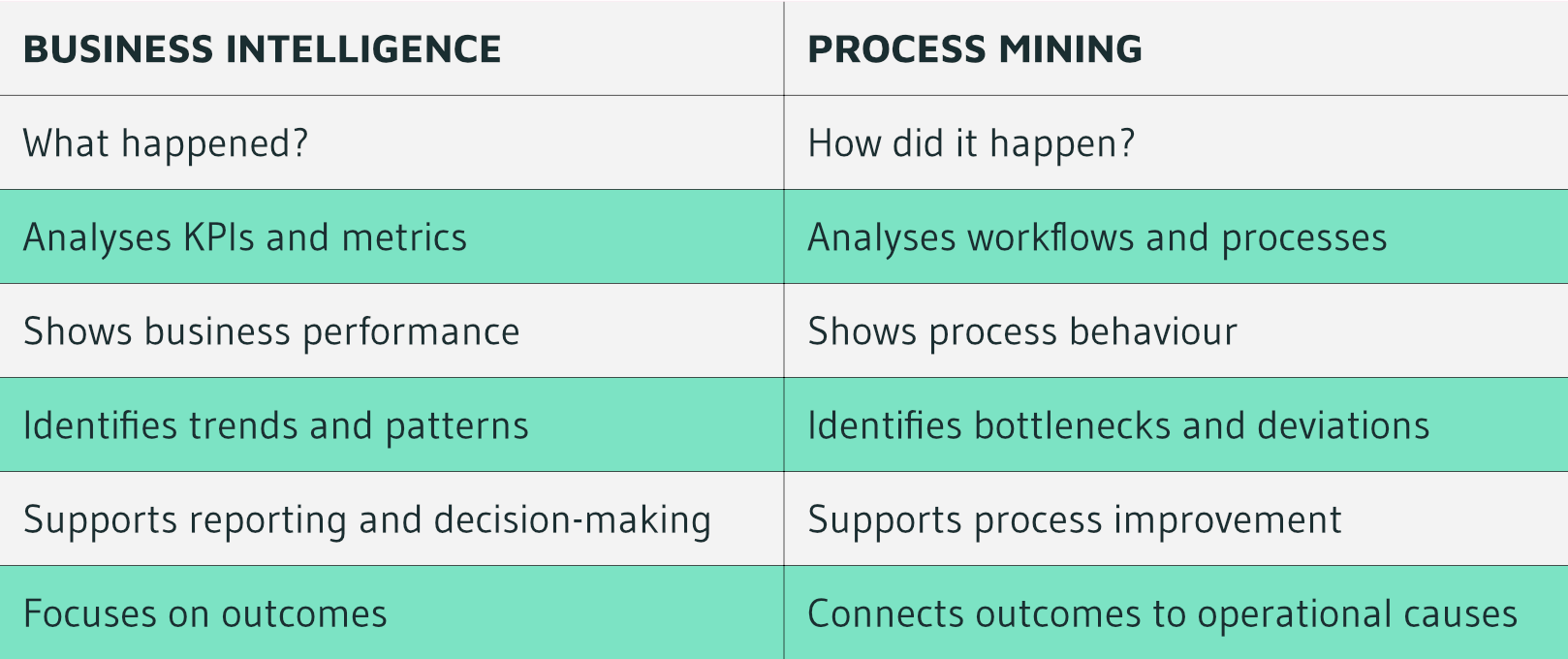
BI tells you where performance is changing. Process mining helps you understand the process behaviour behind that change.
A dashboard might show invoice processing times climbing, and BI can tell you which regions or suppliers are worst affected. Process mining goes further, tracing the actual workflow:
Invoice Received > Registered > Validated > Matched > Approved > Posted > Paid
It might reveal invoices repeatedly falling into exception workflows after failed matching, creating the manual reviews driving the delay.
BI says: Invoice processing performance is deteriorating.
Process mining answers: Where the process is slowing down, and what's causing it.
No, it builds on it.
Business Intelligence > Process Mining > Process Intelligence > Improvement and Automation > Continuous Monitoring
Your BI investment still does the job of monitoring KPIs and supporting decisions. Process mining adds a layer that connects those outcomes to the workflows producing them, moving organisations from seeing performance to understanding it.
This isn't process mining vs business intelligence; it's what happened vs how it happened. Together, they connect high-level performance to the processes driving it.
If your dashboards are already telling you something's wrong, the next question is simple: can you see the process causing it?
Verdant Data helps enterprises build on their existing data and BI investments by adding process intelligence that connects business outcomes to operational processes.


Get Updates and announcements from the Verdant Data Team
You can unsubscribe any time. Learn more about our Privacy Policy


.jpg)
.jpg)
.jpg)
.jpg)


.jpg)















.jpg)
%20(1).jpg)


.jpg)

.jpg)
.png)


