


Modern business processes rarely follow a single, clean sequence.
An order can contain multiple products, those products can be delivered separately; invoices can cover different items, and a single payment may settle several invoices. When organisations try to analyse these processes using one case ID, important relationships can disappear.
Object-centric process mining (OCPM) provides another way to look at the data.
Instead of forcing every event into one case, OCPM analyses events, business objects and the relationships between them. This makes it particularly useful for complex enterprise processes involving multiple interconnected objects.
Traditional process mining generally starts with a case.
For example:
The resulting event log might look like:
Order → Approved → Picked → Shipped → Invoiced
This works well when there is a clear case notion.
But consider a typical order-to-cash process:
Customer → Order → Order Item → Delivery → Invoice → Payment
These are different business objects, each with their own relationships and potentially their own lifecycle.
Object-centric process mining allows those relationships to remain visible rather than flattening everything into a single case.
Academic research describes OCPM as an approach that avoids forcing events into mutually exclusive cases and instead preserves the relationships between multiple objects.
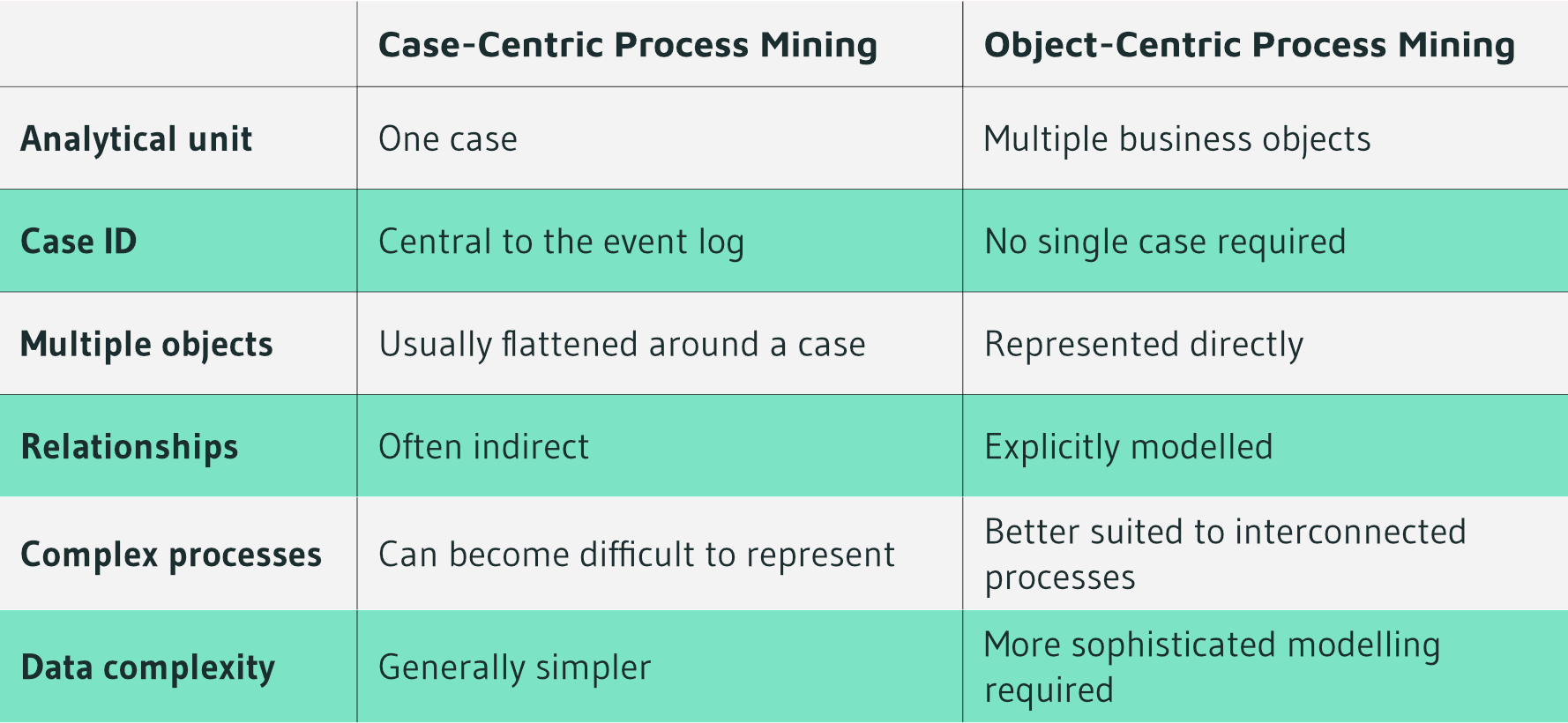
This does not mean OCPM replaces traditional process mining.
If a process has a clear case, such as a customer support ticket moving from creation to resolution, a case-centric approach may still be the most practical option.
The question is whether the business process actually has one meaningful case.
At a high level, the process involves:
This creates an object-centric event log (OCEL).
The OCEL standard provides a structured way to represent events, objects, object types, attributes and relationships. OCEL 2.0 also supports object-to-object relationships, making it possible to represent more of the underlying business structure.
Imagine a customer places an order containing five products.
The transaction involves:
Customer → Sales Order → Order Items → Deliveries → Invoices → Payment
One order might be split across three deliveries, while different items could appear on different invoices.
A traditional case-centric model might use the Order ID as the case.
That provides a useful order-level view, but it can make item-level and delivery-level relationships harder to analyse.
An object-centric model can preserve those relationships.
The organisation can then ask questions such as:
This is where OCPM becomes particularly valuable: it can connect problems that appear to belong to separate processes but are actually related through shared business objects.
Real-world research has demonstrated the value of this approach in interconnected procurement processes, where many-to-many relationships can create problems for traditional case-based analysis.
OCPM is particularly relevant where processes involve complex relationships between objects.
Potential use cases include:
Analyse relationships between customers, orders, products, deliveries, invoices, payments and returns.
Connect suppliers, purchase orders, goods receipts, invoices and payments to identify cross-process issues.
Relate production orders, materials, batches, machines, quality inspections and shipments.
Connect suppliers, products, shipments, warehouses and customer orders.
Analyse relationships between customers, assets, service requests, work orders, spare parts and warranty claims.
The common factor is not the industry.
It is process complexity.
The biggest advantage of OCPM is that it can provide a more realistic representation of complex operational processes.
It can help organisations:
However, OCPM is not a shortcut around data problems.
Organisations still need:
The model itself can also become difficult to interpret if too many objects and relationships are included.
More data does not automatically mean better insight.
The objective should be to model the objects that are actually relevant to the business question.
There is another reason object-centric process mining is gaining attention: AI needs reliable operational context.
AI can generate recommendations, predictions and actions, but those capabilities become considerably more useful when they are grounded in what is actually happening inside the organisation.
OCPM can provide structured context around:
Recent research is exploring the connection between object-centric process mining, process intelligence and AI.
But OCPM should not be treated as an automatic solution for enterprise AI. Data quality, governance and process understanding remain essential.
Object-centric process mining is important because business processes are often more interconnected than traditional case-based event logs suggest.
If an organisation can accurately analyse a process using one meaningful case ID, traditional process mining may be enough.
But when orders, products, deliveries, invoices, customers, suppliers or other objects interact across multiple processes, forcing everything into one case can hide important relationships.
That is where OCPM can provide a more complete view.
The strategic question is therefore not:
"Should we replace traditional process mining?"
It is:
"Is our business process genuinely case-centric, or are we forcing a network of interacting objects into a single case?"
For organisations facing the second situation, object-centric process mining could be an important next step towards more connected, measurable and actionable process intelligence.
Technical and academic sources
Explore more from Verdant Data


Get Updates and announcements from the Verdant Data Team
You can unsubscribe any time. Learn more about our Privacy Policy


.jpg)
.jpg)
.jpg)
.jpg)

.jpg)

.jpg)



















.jpg)
%20(1).jpg)



.jpg)

.jpg)
.png)


