



Most organisations know something is wrong before they can prove it. The invoice approval cycle is taking too long. Customer onboarding takes longer than it should. Costs are rising in a process that was supposed to be optimised three years ago. Everyone has a theory. Nobody has the data to settle it.
Process mining fixes that. But before we get to what it can do, it helps to understand what it actually is, because for most people who encounter the term for the first time, the name doesn't give much away.
Process mining is an analytical technique that uses the data your business systems already generate to build an exact picture of how work actually happens, not how you think it happens, and not how the process map on the wall says it should happen.
Every time someone raises a purchase order, approves an invoice, onboards a customer, or closes a support ticket, your systems record it. There's a timestamp, a user, and a status change. Process mining reads those records, called event logs, and reconstructs the real sequence of steps, every variant, every detour, every delay.
Think of it like this: your business has been leaving a detailed paper trail for years. Process mining is the tool that finally reads it.
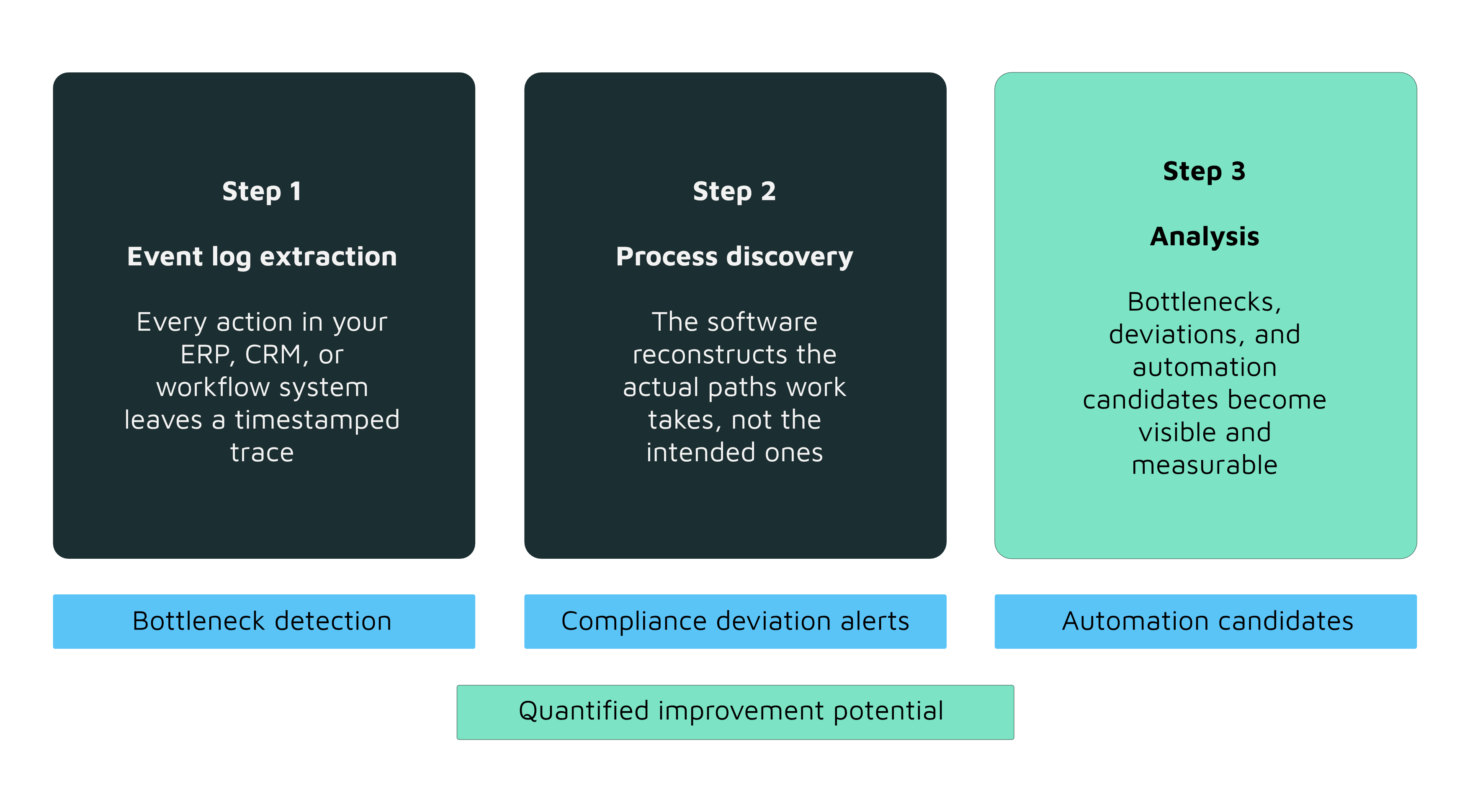
The mechanics break down into three stages.
The diagram above shows the flow, but here's the substance behind each step.
First, event logs are extracted from your source systems, SAP, Salesforce, ServiceNow, whatever your operations run on. These logs contain at least three fields: a case ID (the order, the customer, the ticket), an activity name (approved, escalated, returned), and a timestamp.
Second, the process mining software runs discovery algorithms across those logs to reconstruct the actual process flows. This is where things get revealing. Most organisations expect to see one or two variants of how a process runs. They typically find dozens, sometimes hundreds. Some are efficient. Others involve loops, manual workarounds, and unintended steps.
Third, the analysis layer makes sense of what's been found. Which variants are causing the most delay? Where do compliance deviations cluster? Which cases share characteristics that predict a bad outcome? This is where process mining moves from interesting to actionable.
The most common reaction when an organisation runs process mining for the first time is a version of: "We knew it was bad, but we didn't know it was that bad."
Here are four things that typically surface:
Bottlenecks. A step that should take two hours routinely takes four days, but only when it involves a particular team, system, or approval tier. Process mining pinpoints exactly where the slowdown occurs and quantifies the impact on throughput.
Rework loops. Cases that get sent back, corrected, and resubmitted introduce hidden costs and delays that never appear on a process map. In purchase-to-pay processes, rework rates of 20-30% are not unusual. Most finance teams have no idea.
Compliance deviations. In regulated industries, certain steps must happen in a specific sequence. Process mining can run continuous conformance checking, comparing actual execution against the defined model, and flag deviations in near real time, rather than catching them in a quarterly audit.
Automation candidates. Before you spend money on RPA or AI agents, you need to know which processes are stable, high-volume, and rules-based enough to automate reliably. Process mining provides evidence-based. It also tells you which processes need fixing before you automate them, because automating a broken process just makes it fail faster.
Business process management (BPM) is the discipline of designing, documenting, and improving how processes should work. It's inherently forward-looking and often based on workshops, interviews, and existing documentation.
Process mining is diagnostic and backwards-looking. It tells you how processes worked, based on evidence from your systems.
The two are complementary, not competing. BPM gives you the target state. Process mining tells you where you're actually starting from and keeps monitoring whether improvements hold over time. Organisations that use both tend to move significantly faster through transformation programmes because they're not arguing about assumptions.
The honest answer is that the case for process mining has always been strong, but the urgency is new.
Three things have converged. First, enterprises are sitting on more operational data than at any previous point in history. ERP systems, cloud platforms, and SaaS tools continuously generate event logs; the raw material for process mining has never been more abundant or accessible.
Second, AI and agentic automation have raised the stakes for understanding your processes before you automate them. Deploying AI agents into poorly understood workflows is an expensive way to discover their failure modes. Process intelligence gives automation initiatives a factual foundation instead of a hopeful one.
Third, boards and CFOs are demanding evidence. Digital transformation budgets have faced serious scrutiny over the last few years, and rightly so. Process mining is one of the few tools that can quantify the baseline, model the potential for improvement, and track whether it was actually realised. That accountability is increasingly non-negotiable.
At Verdant, we've worked across more than 100 process mining projects with clients spanning financial services, professional services, and operations-heavy enterprises. The organisations that get the most value aren't necessarily the ones with the most sophisticated tech stacks; they're the ones willing to look honestly at what the data shows before deciding what to do about it.
No technology deserves a free pass on limitations, and process mining is no exception.
It can only analyse what your systems record. If a significant portion of work happens outside your core systems, in spreadsheets, email threads, or verbal handoffs, that activity is invisible to traditional process mining. Task mining tools and more recent agentic process intelligence approaches are beginning to address this, but the gap is real and worth acknowledging before you scope a project.
Implementation also requires clean, accessible event logs. Organisations with fragmented data architectures or poor data quality will spend meaningful time on extraction and preparation before they see their first process map. That's not a reason not to start; it's a reason to be honest about the timeline.
Process mining answers the question: What is happening in my operations? Process intelligence takes the next step, using that visibility as the foundation for continuous monitoring, predictive analytics, and intelligent automation.
If process mining is the diagnostic scan, process intelligence is the ongoing health system built around it. We'll cover the distinction in more depth in the next databite post, but the short version is this: process mining gets you the facts. Process intelligence puts them to work.
If you're building the internal case for a process mining initiative, the ROI argument matters as much as the technical one. We've written a practical guide on structuring that conversation for CFOs and transformation sponsors, it's in the databite archive.
If you'd rather talk through your specific situation, we're easy to reach at hello@verdantdata.ch or via the Book a demo page. No pitch deck required for a first conversation.


Get Updates and announcements from the Verdant Data Team
You can unsubscribe any time. Learn more about our Privacy Policy


.jpg)
.jpg)
.jpg)
.jpg)


.jpg)

.jpg)



















.jpg)
%20(1).jpg)



.jpg)

.jpg)
.png)


