


.jpg)
A digital twin of an organization (DTO) is a live, data-driven model of how your business actually runs- its people, processes, applications, and data- built so leaders can simulate a change before committing budget or headcount. Gartner published its first-ever Magic Quadrant for DTO platforms in 2026, and both Celonis and SAP publicly claim Leader status. That's your signal this has moved from analyst theory to boardroom budget line.
This is a quick, practical breakdown for anyone hearing "DTO" in vendor pitches and wanting a straight answer.
Gartner defines a DTO as a dynamic software model that uses operational and contextual data to represent how an organization runs its business, adapts to change, and delivers value. SAP frames it across four dimensions: people, processes, applications, and data.
It's not a static org chart or a workshop diagram. It's rebuilt continuously from the digital traces your systems generate, which means it's only as trustworthy as the process data underneath it.
Three things converged in 2026:
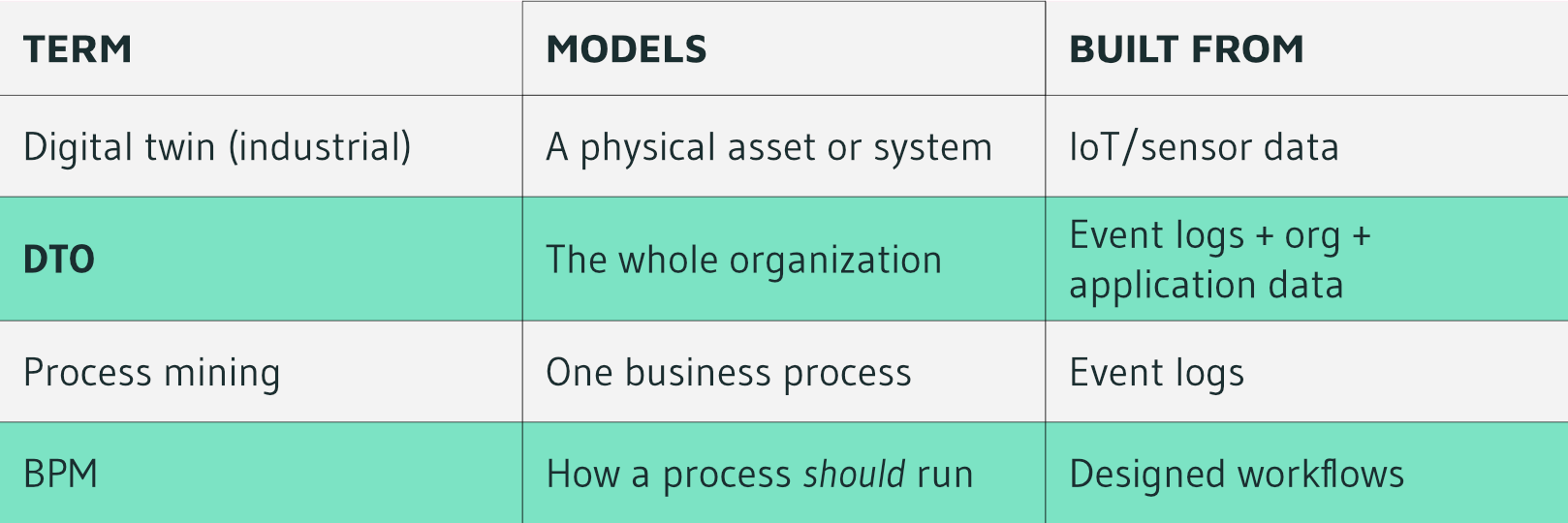
Process mining is the engine underneath a credible DTO. Gartner has said as much since its 2018 Market Guide for Process Mining, and more recently projected that 25% of global enterprises will adopt process mining as a first step toward a DTO by 2026. Skip that foundation, and a "DTO" is really just an expensive org chart with a UI.
IBM's Institute for Business Value found that 72% of surveyed executives reported improved operational efficiency from process mining, 65% saw employee engagement gains, and organizations using it reported roughly 8% higher incremental annual growth.<sup>[7]</sup> A DTO extends those gains organization-wide instead of process-by-process — finance can simulate a policy change before rolling it out, supply chain can stress-test a disruption scenario, risk teams can test controls continuously instead of via sampled audits.
This is the part worth sitting with. AI agents approving invoices or rerouting tickets need to understand how the organization actually works, not how a slide deck says it works. A DTO is that context layer. Gartner and vendors in the category describe it as symbiotic: AI makes the DTO more useful by reasoning over it; the DTO makes AI safer by grounding it in current, verified reality.
If you're scaling agents faster than you're building the operational context to ground them in, that's a governance gap, not an AI capability gap, and a DTO, even scoped to one high-risk process, closes it faster than adding model sophistication does.
Don't scope the whole organization on day one. Validate one process with real event data, layer in conformance checking, then expand. A DTO built on assumed process flows instead of mined ones isn't a digital twin; it's a guess with better branding.
Verdant Data helps enterprise teams build the process-mining foundation a credible DTO requires. Get in touch to talk through where your organization stands.


Get Updates and announcements from the Verdant Data Team
You can unsubscribe any time. Learn more about our Privacy Policy


.jpg)
.jpg)
.jpg)
.jpg)



.jpg)


















.jpg)
%20(1).jpg)

.jpg)

.jpg)
.png)


