



There is a quiet transformation happening inside enterprise IT. It isn't just about the "AI agents" making headlines; it’s about a fundamental shift in the architecture beneath them.
CIOs today face a paralyzing dilemma: the hype surrounding AI agents is creating chaos in application roadmaps. Do you invest in a new ERP? Upgrade your CRM? Or do you wait to see which AI layer makes those investments irrelevant?
To answer this, Gartner has introduced a strategic framework known as AIR Layers. It isn't a software solution, but rather an "architectural blueprint." It suggests that to survive the AI era, enterprises must decouple their technology into three distinct layers, each with its own pace of change and its own relationship to intelligence.
Understanding these three layers is no longer just for architects; it is now a prerequisite knowledge for any leader serious about digital transformation.
For decades, enterprise applications were "all-in-one." Your ERP or CRM holds your data, your business logic, and your user interface in a single, rigid bundle. In this model, the application was the process.
Agentic AI breaks this. An AI agent doesn't care about a pretty user interface; it cares about data access and the ability to act. When logic is trapped inside a monolithic application, the agent is throttled. As Gartner has noted, enterprise value is shifting from simple AI models to "agentic orchestration", where systems of record give way to systems of action, and orchestrated outcomes become the primary goal.
To visualize Gartner’s AIR framework, imagine building a house designed for the future.
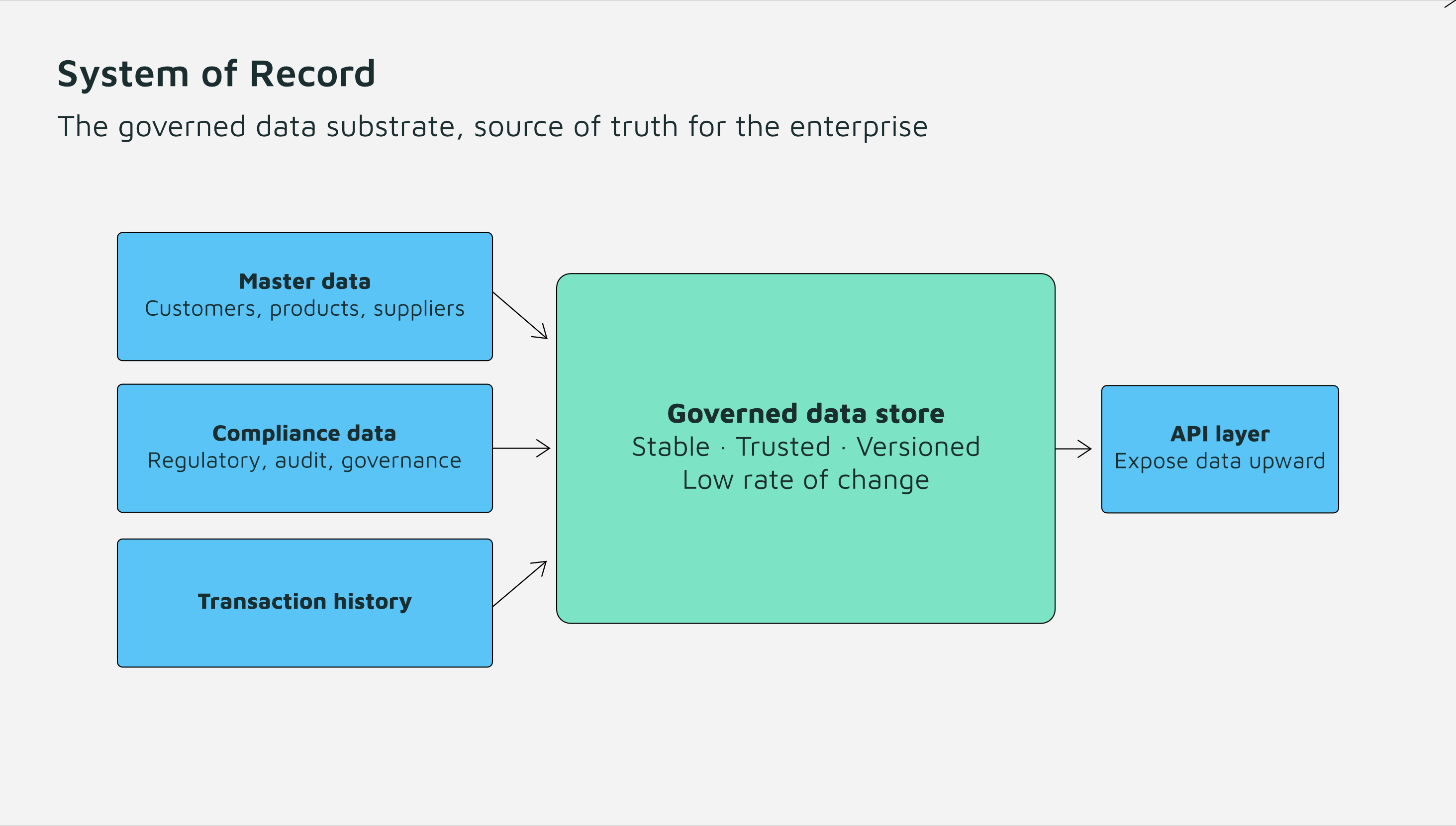
This is your source of truth: the ERP, the HRMS, the financial ledger. In the AIR framework, this layer doesn't disappear; it is "repositioned." Its job is no longer to drive the process, but to serve as a stable data substrate. * The Shift: It stops being the "brains" of the operation and becomes the "memory." It must be governed, trusted, and, most importantly, accessible via APIs.
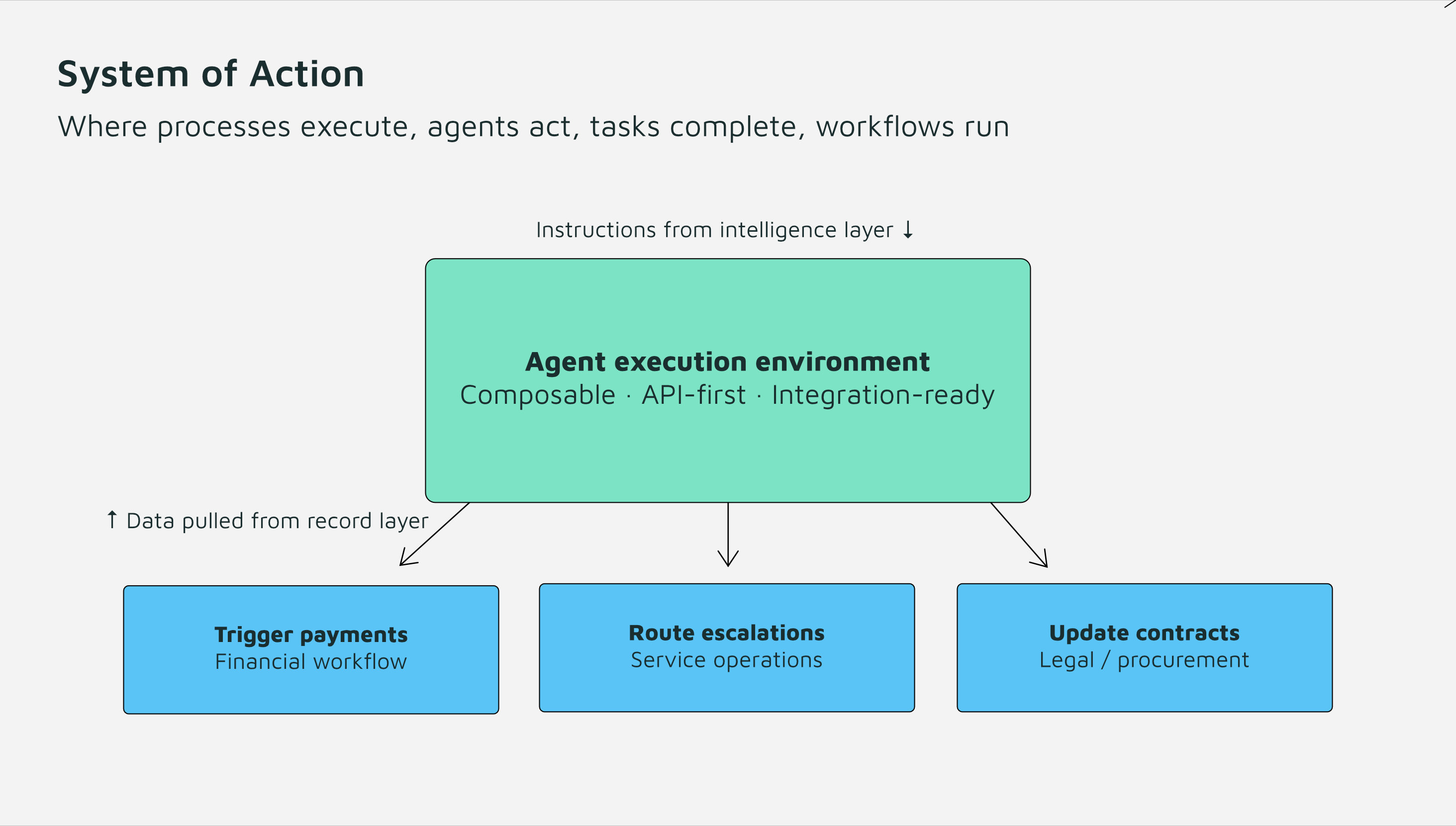
This is the operational layer where work actually happens. In an agentic architecture, this is where AI agents live and breathe. They pull data from the foundation and execute tasks, triggering payments, updating contracts, or routing escalations.
The Shift: This layer must be "composable." It’s built to receive instructions from the intelligence layer and integrate seamlessly with various tools to get the job done.
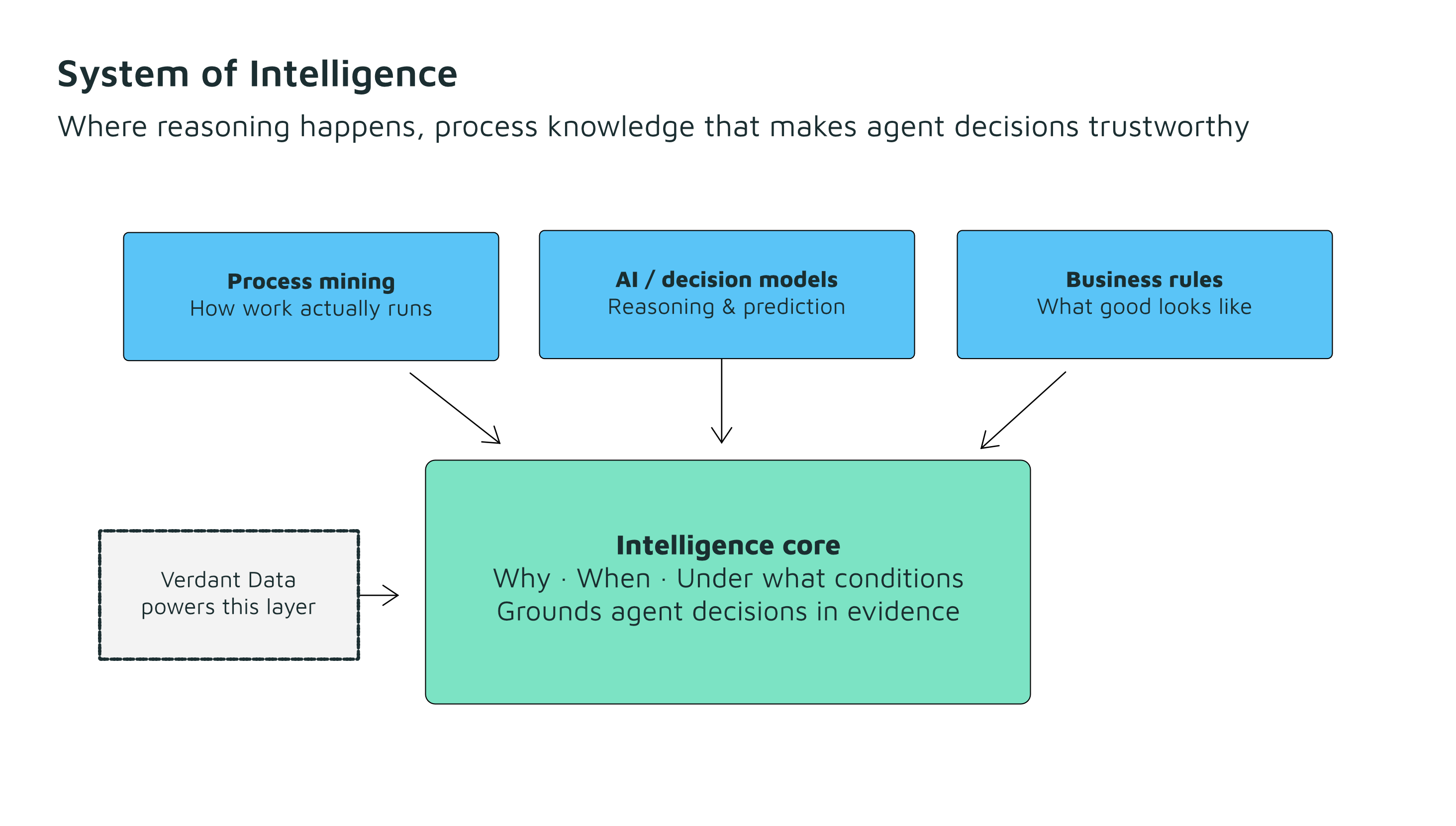
This is the new, critical layer most enterprises are missing. It’s where reasoning and decision-making happen. While the System of Action executes, the System of Intelligence decides why, when, and how.
The Shift: This layer holds the "business context." It’s where AI models converge with business rules and performance baselines to ensure that when an agent acts, it does so intelligently and safely.
The reason Gartner advocates for "decoupling" these layers is simple: Agility. When your data, logic, and execution are locked inside a single vendor’s platform, you are a prisoner to their roadmap. Every AI breakthrough requires a massive platform decision. By separating these layers, you gain Architectural Flexibility. You can upgrade your "Intelligence" (the AI reasoning) without having to migrate your "Record" (the 20-year-old ERP data).
Gartner projects that agentic AI could drive $450 billion in software revenue by 2035. Organizations that remain tied to a "coupled" architecture will find themselves locked out of this value, unable to move at the speed the market demands.
At Verdant Data, we see the AIR framework as the architectural validation of what Process Intelligence has provided operationally for years.
Without Process Intelligence, the "System of Intelligence" is built on assumptions, someone’s best guess of how a process should run. When an agent makes decisions based on assumptions, it produces mediocre or even risky outcomes.
With Process Intelligence, the Intelligence layer is built on evidence. It provides a continuous, data-driven map of how the organization actually behaves, identifying bottlenecks, variants, and high-performance triggers. It provides the "contextual guardrails" that make AI agents trustworthy.
The AIR framework changes how we evaluate technology investments:
Agentic AI isn't a reason to stop investing; it's a reason to restructure. The goal isn't to replace your existing systems, but to liberate them from a role they were never designed to play: being the "brains" of your enterprise.
By building a dedicated Intelligence layer, grounded in real-world process data, you aren't just surviving the AI disruption. You are positioning your organization to lead it.


Get Updates and announcements from the Verdant Data Team
You can unsubscribe any time. Learn more about our Privacy Policy


.jpg)
.jpg)


.jpg)

.jpg)


















.jpg)
%20(1).jpg)

.jpg)

.jpg)
.png)


