


Business process management has been declared obsolete more than once in the past decade, by agile, by RPA, and now by AI. Each time, the discipline has not collapsed. It has evolved.
The reality in 2026 is more nuanced than the hype suggests. AI and process intelligence have genuinely transformed how organisations discover and automate their operations. But the underlying discipline, understanding how work actually flows before optimising it, is as critical as ever. The organisations winning right now are not the ones who replaced BPM with AI. They are the ones who built AI on top of solid process intelligence.
Business process management is a management discipline, not a product. It is a structured approach to identifying how work moves through an organisation, modelling that flow, measuring performance, and continuously optimising for efficiency and value. The software exists to support that discipline, not replace it.
This distinction matters enormously in 2026, because the most common failure mode in AI-led automation is not a technology problem. It is a process of understanding the problem. Organisations are automating processes they do not fully understand, and AI amplifies both the efficiency gains and the structural flaws beneath them.
Process discovery is now data-driven
AI-powered process mining reconstructs how work actually flows by analysing event log data from ERP, CRM, and workflow systems, capturing every deviation, bottleneck, and workaround that never appeared in the design documentation. It collapses months of manual discovery work into days.
Agentic AI has raised the ceiling on automation scope
Unlike traditional RPA, AI agents can plan, reason, and make decisions within a workflow context. They handle exceptions, route tasks dynamically, and adjust when circumstances change.

Speed to value has compressed dramatically
Traditional automation projects took six to twelve months to deliver measurable value. Cloud-based automation platforms have compressed this to weeks. Organisations implementing hyperautomation report processing time reductions of over 80% for tasks like invoice management, alongside labour cost reductions of 40%.
For all the transformations above, several realities remain unchanged, and organisations ignore them at their peril.
ROI scrutiny has intensified. Only 15% of AI decision-makers can currently tie their AI investments to measurable EBITDA improvement. As spending scales, the pressure to demonstrate real business value is growing sharply.

That is not a technology failure. It is a readiness failure, driven by legacy integration complexity, governance gaps, skill shortages, and operating models that have not caught up with the technology.
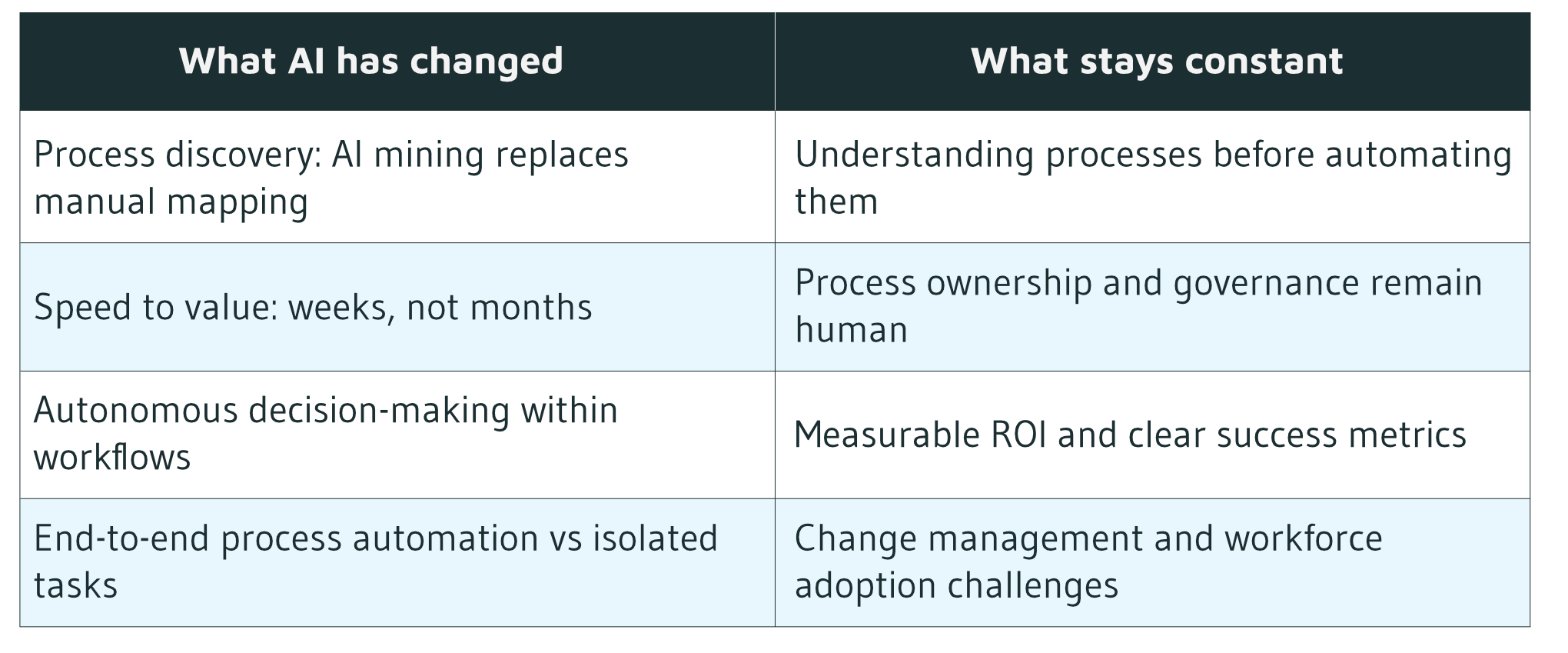
The organisations achieving the highest returns share a common approach: mine before you automate, prove before you scale, govern before you grow.
By the end of 2026, Gartner projects 30% of enterprises will be automating more than half of their network activities, up from less than 10% in mid-2023. The organisations in that 30% are not the ones with the most AI tools. They are the ones who built on the clearest process intelligence foundations.
Ready to put process intelligence to work?
If your organisation is still mapping processes manually, or automating without understanding what's actually broken, now is the time to change your approach. Subscribe for monthly deep-dives on process intelligence, agentic automation, and the operational strategies that scale.


Get Updates and announcements from the Verdant Data Team
You can unsubscribe any time. Learn more about our Privacy Policy


.jpg)
.jpg)
.jpg)
.jpg)


.jpg)

.jpg)



















.jpg)
%20(1).jpg)

.jpg)


.jpg)
.png)


